Mediterranean Basin - Shaded Relief, c. 1958. National Archives
During WWII, women were needed behind enemy lines for their ability to inconspicuously communicate. After WWII ended, women were expected to return to old roles as housewives. The women of the SOE/OSS, and others who entered the workforce, saw their contributions be diminished.
“The work which I undertook was of a purely military nature in an enemy occupied country. When the time for open warfare came we planned and executed open attacks on the enemy. I spent a year in the field and had I been caught I would have been shot, or worse still, sent to a concentration camp. I consider it most unjust to be given a civilian decoration. The men received military decorations. Why is this discrimination with women when they put the best of themselves into the accomplishment of their duties?”
-Pearl Witherington, SOE agent, c. 1945 (Thomas and Lewis 271)
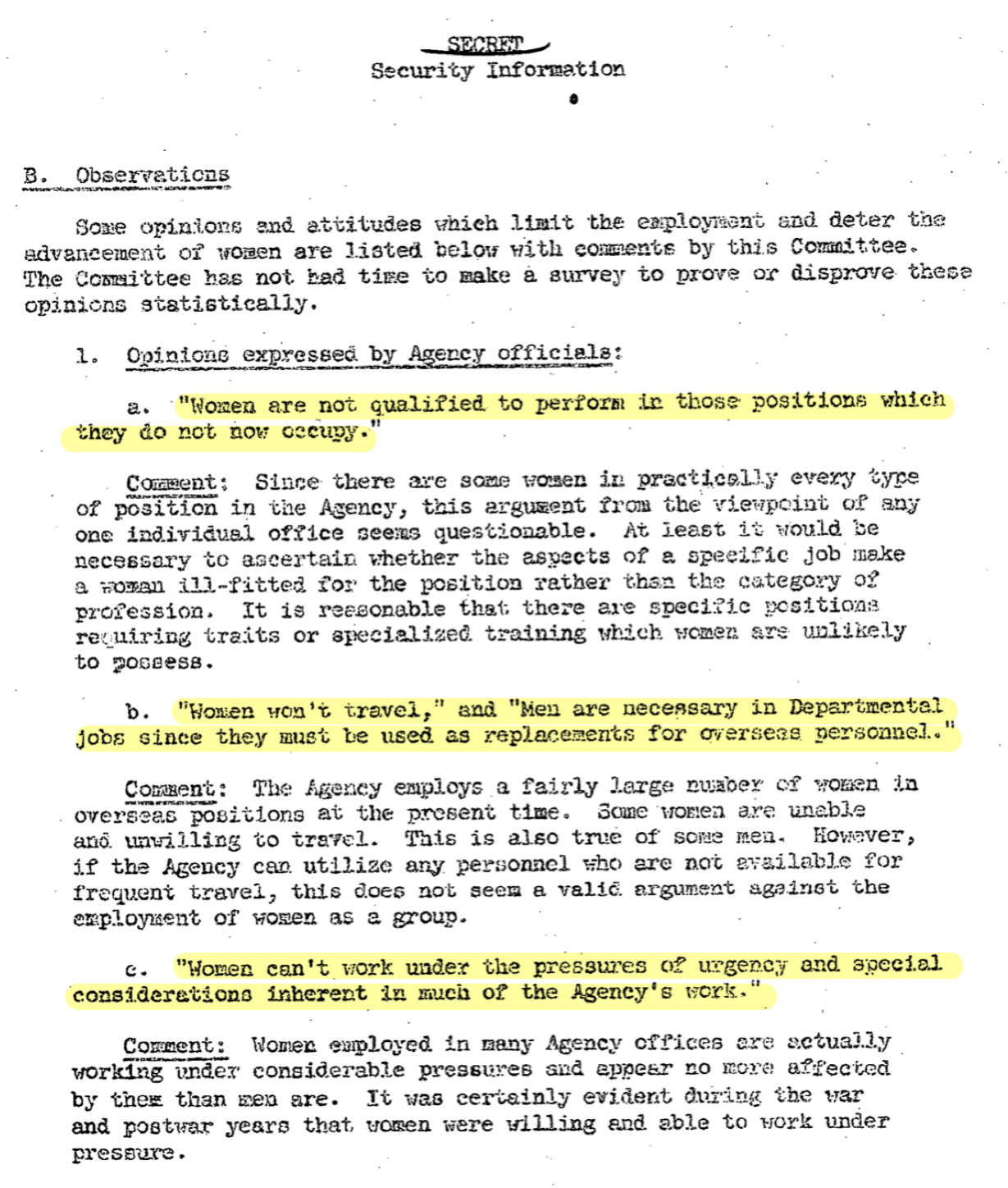
As intelligence agencies, like the CIA, were formed, veterans who risked their lives for their countries were relegated to desk jobs simply because of their gender. The CIA would even conduct internal investigations to understand why women in the organization weren’t advancing alongside men.
"We had no female case officers in my station. Women were responsible for support operations such as research, analysis, and office management. I feel women are just not as stable as men in critical positions."
- Elizabeth McIntosh recollecting comments made to her in the CIA in the 1960s (McIntosh 242)
Report of the Committee on Professional Women in the Overt Offices, November 1, 1953. CIA
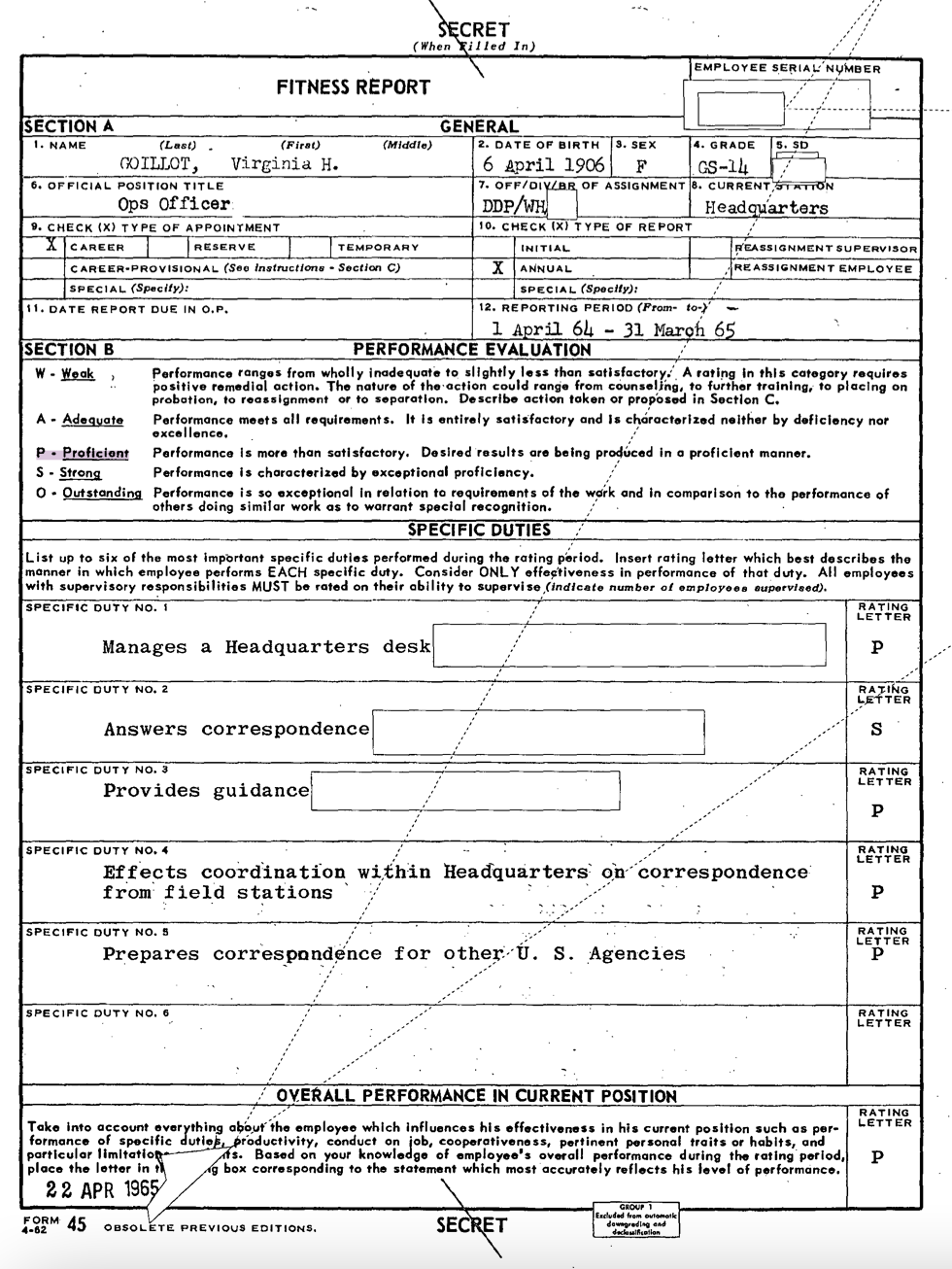
Hall wasn't exempt. Her experience and communication skills necessary for understanding enemy situations were dismissed when she desired an operative role as an early CIA employee.
Virginia Hall Goillot Fitness Report, April 22, 1965. CIA
“She was a sort of embarrassment to the noncombatant CIA types, by which I mean bureaucrats. Her experience and abilities were never properly utilized. At the very least she should have been lecturing to trainees at the CIA indoctrination ‘farm’ near Williamsburg. She was out of the loop, the proverbial round peg, and through no fault of her own. I really ached over her and her low-level status.”
- E. Howard Hunt, c. 1974 (Purnell 509)
“Gung-ho lady left over from OSS days overseas. Young women in sweater sets and pearls listened raptly to Virginia Hall gas with muscular paramilitary officers who would stop by her desk to tell war stories. She was elegant, her dark brown hair coiled on top of her head with a yellow pencil tucked into the bun. She was always jolly when she was around the old boys. She was a presence!”
- Angus Thuermer (McIntosh 127)
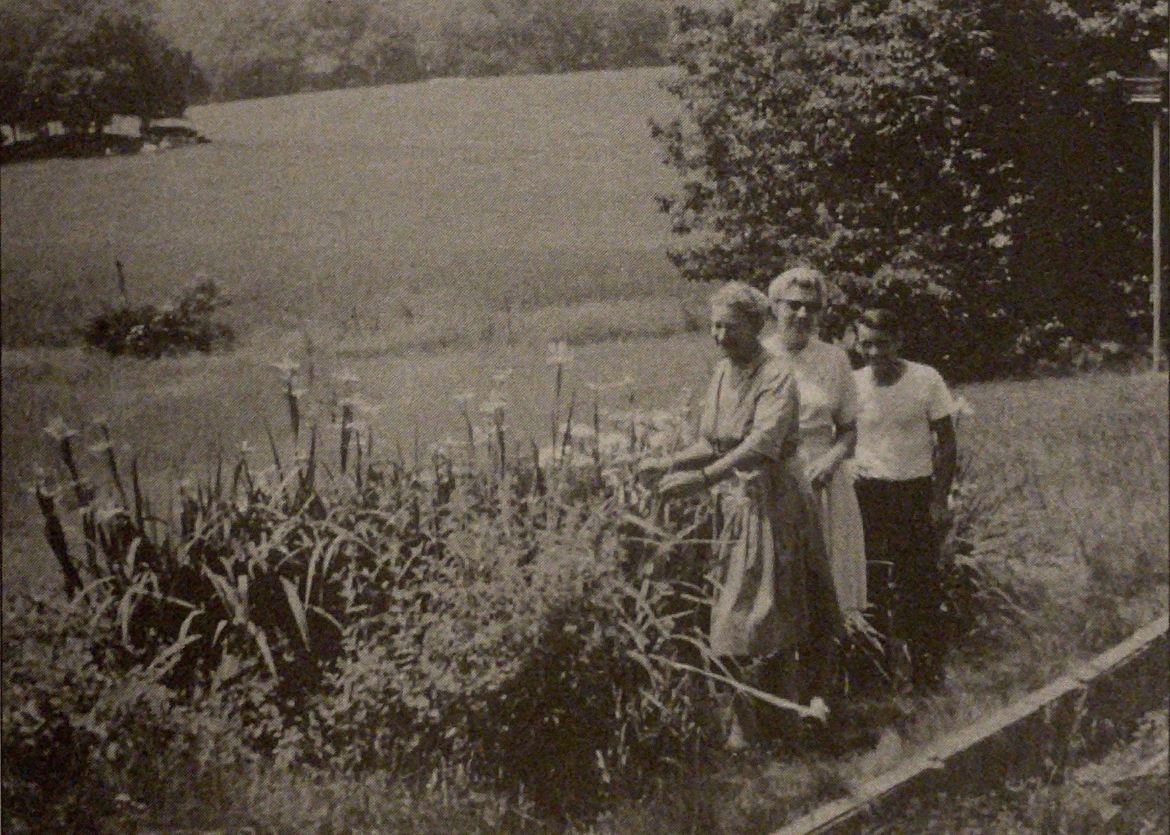
"Virginia, left, and Paul with an unknown friend, touring their yard at their Maryland home" c. 1982. Judith L. Pearson
"In peacetime, our society somehow felt it could afford the luxury of wasting the talents of women and leaving the Virginia Halls of this world deep in the file drawer."
- Nora Slatkin, former executive director at the CIA, 1996 (Lake)
Virginia retired from the CIA in 1966 and lived with her husband until her death on July 8, 1982.
“He was shorter than Dindy, but their early married life was fun. They found a great deal of happiness in shared memories.He was good for her. He lightened her life. If she asked him to take a few days off with her and go fishing, he was always ready and obliged.”
- Lorna Catling, 1994 (McIntosh 126)
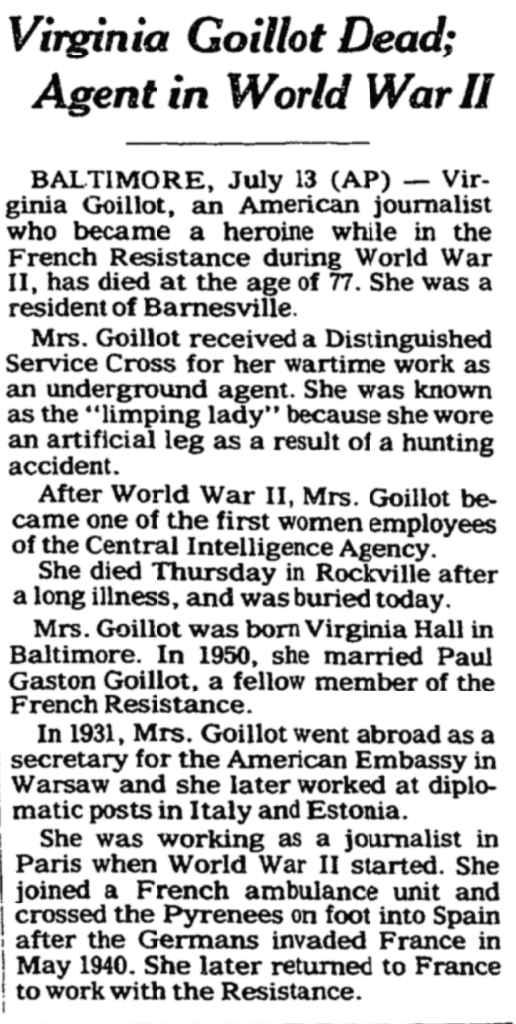
July 14, 1982. New York Times
Despite challenges, Hall and the SOE/OSS women forged a space in covert operations for women, and women’s presence in the intelligence community and special operations has grown upon the obstacles they overcame.
“USSOCOM and Special Operations have a proud and successful history in leading integration efforts. One of our predecessor organizations, the Office of Strategic Services, is a good example. One in five members was female . . . Major General ‘Wild’ Bill Donovan, himself a Medal of Honor recipient, described these women as vital to an organization which touched every theatre of war."
- Statement from USSOCOM on SECDEF's Women in Service Review Decision, 2015
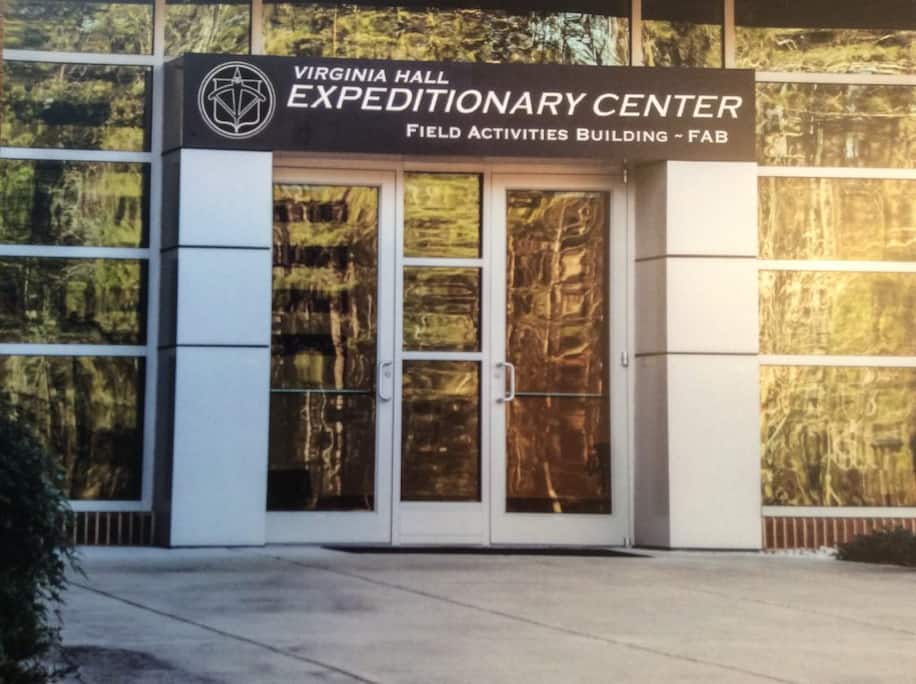
CIA training facility named after Virginia Hall, c. 2017. Washington Post
"[older, male CIA agency chiefs] became feudal barons and could never consider women as their equals. Our new career women are proving them wrong. Historically, I suppose you could say that the women of the OSS prepared the groundwork for their sisters who came after them in CIA."